A complete SEO, AEO, and monetization research for Competitor Digital Marketing Strategy Analysis -Prompt using ChatGPT
A competitor digital marketing strategy analysis prompt helps marketers analyze a competing webpage’s SEO, keywords, AEO, monetization methods, DA, PA, and content strategy using ChatGPT in a structured, actionable format.
AI Overview Summary
A competitor digital marketing strategy analysis prompt is a structured instruction designed to help marketers use ChatGPT to analyze competing webpages. It evaluates SEO structure, keyword targeting, AEO readiness, monetization methods, authority signals, and conversion strategy, delivering insights in table format for faster decision-making.
Why This Competitor Digital Marketing Strategy Analysis Prompt Works
Most competitor research tools give data, but not strategy.
This prompt is designed to:
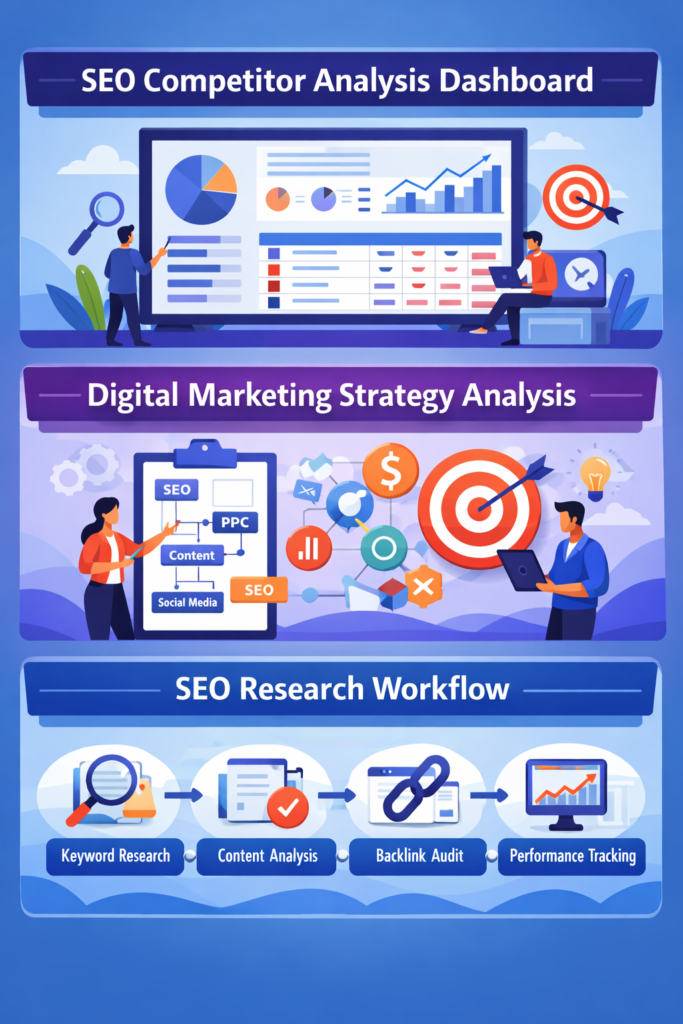
- Reverse-engineer why a competitor ranks
- Identify keyword gaps with low competition
- Analyze monetization and funnel structure
- Uncover AEO and featured snippet tactics
- Create a clear outranking roadmap
Unlike generic SEO prompts, this one forces ChatGPT to think like:
- An SEO strategist
- A content marketer
- A CRO consultant
- A digital business analyst
All in one output.
Key Takeaways
| Insight | Explanation |
|---|---|
| Purpose | Analyze competitor SEO and digital marketing strategy using ChatGPT |
| Output Format | Structured tables for clarity and comparison |
| SEO Coverage | Keywords, on-page SEO, AEO, DA, PA |
| Monetization Coverage | Affiliate, product, ads, funnels |
| Best Use Case | SEO professionals and content strategists |
Read ChatGPT prompts for social media optimization
Who Should Use This Prompt?
This competitor SEO and digital marketing analysis prompt is ideal for:
- SEO professionals
- Digital marketers
- Founders & solopreneurs
- Content strategists
- Affiliate marketers
- SaaS & product marketers
If you publish content and want to outrank competitors instead of guessing, this prompt is for you.
Related Concepts and Entities
This competitor analysis prompt relates to the following digital marketing concepts:
- Search Engine Optimization (SEO)
- Answer Engine Optimization (AEO)
- Keyword Research and Search Intent
- Competitive Analysis
- Content Strategy
- Conversion Rate Optimization (CRO)
What This Prompt Analyzes (In Detail)
This prompt forces ChatGPT to break down a competitor page across 11 strategic layers:
- Page intent & funnel stage
- Primary, secondary & LSI keywords
- Short-tail vs long-tail keyword targeting
- On-page SEO structure
- AEO (Answer Engine Optimization)
- Featured snippet readiness
- Monetization & revenue models
- Conversion rate optimization (CRO)
- EEAT & authority signals
- DA / PA estimation
- Outranking strategy & gaps
All results are delivered in clean, professional tables.
When to Use This Prompt
Use this competitor digital marketing strategy analysis prompt when you need to:
- Analyze why a competitor ranks higher
- Identify low-competition keyword gaps
- Understand a competitor’s monetization strategy
- Plan content that targets AI Overviews and featured snippets
- Build a data-driven SEO roadmap
How to Use This Competitor SEO Analysis Prompt
- Copy the prompt below
- Paste it into ChatGPT
- Replace the competitor URL
- Run the prompt
- Use the output to plan content, SEO, and monetization
You can repeat this process for every competitor page you want to analyze.

🔥 COPY-PASTE PROMPT: Competitor Digital Marketing, SEO, AEO & Monetization Analysis
You are a Senior Digital Marketing Strategist, SEO Lead, and Competitive Intelligence Analyst with deep expertise in:
•	On-page & Technical SEO
•	Keyword Research (Primary, Secondary, LSI, Short-tail, Long-tail)
•	AEO (Answer Engine Optimization)
•	EEAT, Authority & Trust Signals
•	Content Strategy & Monetization Models
•	Conversion Rate Optimization (CRO)
•	Competitive Gap & Outranking Strategy
You analyze competitor pages as if preparing a paid enterprise-level SEO & marketing intelligence report.
Competitor URL: 👉 PASTE URL HERE
________________________________________
🎯OBJECTIVE
Analyze the provided competitor webpage in extreme detail, covering:
•	Digital marketing strategy
•	Traffic acquisition methods
•	On-page SEO & keyword targeting
•	AEO / featured snippet optimization
•	Monetization & revenue streams
•	Authority (DA, PA, EEAT)
•	Conversion optimization
•	Competitive advantages & gaps
________________________________________
📊 OUTPUT FORMAT (MANDATORY RULES)
•	ALL results MUST be presented in TABLE FORMAT
•	Each section must have its own clearly labeled table
•	No bullet lists or paragraphs outside tables
•	Use professional, data-driven language
•	Assume the output will be used by SEO managers, founders, and marketing teams
________________________________________
🧠 REQUIRED ANALYSIS SECTIONS
________________________________________
1️⃣ Page Overview & Strategic Purpose
Elements:
•	Page Type (Blog / Guide / Commercial / Hybrid)
•	Primary Goal (Traffic / Monetization / Authority / Leads)
•	Funnel Stage (TOFU / MOFU / BOFU)
•	Core Search Intent (Informational / Commercial / Transactional / Navigational)
•	Target Audience
•	Evergreen or Time-Sensitive
Put the research in the table format
label in X axis label elements and in y axis Analysis
________________________________________
2️⃣ Keyword Strategy Breakdown
Put the research in the table format
A. Primary Keywords
Keyword  |  Search Intent  |  Competition Level  |  Strategic Role

B. Secondary Keywords
Keyword  |  Search Intent  |  Supporting Section

C. LSI / Semantic Keywords
Keyword  |  Context Used  |  SEO Benefit

D. Short-Tail Keywords
Keyword  |  Volume Type  |  Purpose

E. Long-Tail Keywords
Keyword  |  User Intent  |  Conversion Potential
________________________________________
3️⃣ On-Page SEO Optimization Audit

SEO Elements:
•	Title Tag
•	Meta Description
•	URL Structure
•	H1 Usage
•	H2–H4 Hierarchy
•	Keyword Placement
•	Internal Linking
•	External Linking
•	Image Optimization (Alt Text, Filenames)
•	Content Length vs SERP Avg
•	Readability & UX
•	Page Speed Signals
•	Mobile Optimization
Put the research in the table format
label in X axis label SEO elements and in y axis Quality (High / Medium / Low)  |  Notes
________________________________________
4️⃣ AEO (Answer Engine Optimization) & SERP Features
AEO Factors:
•	Featured Snippet Formatting
•	Question-Based Headings
•	Direct Answer Paragraphs
•	Lists & Tables
•	FAQ-Style Content
•	Conversational Language
•	Schema Markup Signals (Inferred)
Put the research in the table format
label in X axis label AEO Factors and in y axis Present (yes/no)  |  Explanation
________________________________________
5️⃣ Content Strategy & Engagement
Elements:
•	Content Depth
•	Visual Usage
•	Step-by-Step Structure
•	Authority Voice
•	Examples / Proof
•	Comments / UGC
•	Content Refresh Signals
Put the research in the table format
label in X axis label Elements and in y axis Execution |  Purpose
________________________________________
6️⃣ Monetization Strategy
Monetization Method:
•	Affiliate Marketing
•	Own Products / Services
•	Display Advertising
•	Lead Capture
•	Internal Upsells
•	Brand Partnerships
Put the research in the table format
label in X axis label Monetization Method and in y axis Evidence on Page  |  Funnel Role
________________________________________
7️⃣ Conversion Rate Optimization (CRO)
Element:
•	Above-the-fold CTA
•	Inline CTAs
•	Contextual Product Mentions
•	Trust Signals / Social Proof
•	Navigation CTAs
•	Exit-Intent Strategy (Inferred)
Put the research in the table format
label in X axis label Elements and in y axis Location |  Effectiveness
________________________________________
8️⃣ EEAT, Trust & Authority Signals
Signal:
•	Author Credentials
•	Brand Authority
•	Media Mentions
•	Transparency and Disclosures
•	Expertise Demonstration
•	Trustworthiness Signals
Put the research in the table format
label in X axis label Signal and in y axis Observation
________________________________________
9️⃣ Domain & Page Authority (Estimated)
Metric:
•	Domain Authority (DA)
•	Page Authority (PA)
•	Backlink Quality
•	Internal Link Equity
•	Brand Search Demand
Put the research in the table format
label in X axis label Metric and in y axis Estimated Level  |  Notes
________________________________________
🔟 Competitive Advantages & Gaps
Category:
•	Core Strengths
•	SEO Advantages
•	Monetization Advantages
•	Weakness
•	Missed Opportunities
•	Keywords to Steal
Put the research in the table format
label in X axis label Category and in y axis Insights
________________________________________
1️⃣1️⃣ Outranking & Replication Strategy
Area:
•	Content Improvements
•	Keyword Opportunities
•	AEO Optimization
•	Monetization Enhancements
•	Internal Linking
•	Authority Building
Put the research in the table format
label in X axis label Area and in y axis Recommendation
________________________________________
1️⃣2️⃣ Generate a Competitor Keyword Gap Matrix
________________________________________
1️⃣3️⃣ Build a keyword-to-content roadmap
________________________________________
1️⃣4️⃣ A Full Pillar Page Outline
________________________________________
✅ FINAL INSTRUCTIONS
•	Be analytical, not generic
•	Do not invent data — infer logically where needed
•	Treat this as a professional SEO intelligence report
•	Do not skip any section
________________________________________
How This Prompt Helps You Outrank Competitors
Using this competitor digital marketing strategy analysis prompt allows you to:
- Identify low-competition keyword opportunities
- Improve on-page SEO structure
- Optimize for AEO and AI search
- Build stronger topical authority
- Reverse-engineer monetization funnels
- Create content Google and AI engines prefer
It turns competitor research into clear, actionable strategy.
Why This Prompt Is Optimized for SEO & AEO
This prompt is intentionally structured to support:
- Search Engine Optimization (SEO)
Keyword mapping, internal linking, content depth, and SERP intent. - Answer Engine Optimization (AEO)
Direct answers, tables, FAQs, and structured outputs that AI tools prefer.
This makes it effective not only for Google rankings, but also for:
- ChatGPT
- AI Overviews
- Perplexity
- Voice search & future AI search engines
How AI Search Engines Use This Prompt
AI-powered search engines analyze structured content to generate direct answers. This prompt is designed to produce outputs that are easily interpreted by AI systems because it:
- Uses explicit roles and objectives
- Forces structured table-based outputs
- Maps keywords to intent and funnel stages
- Separates SEO, AEO, monetization, and authority analysis
This makes it suitable for modern AI search experiences, including Google AI Overviews.
Frequently Asked Questions :
A competitor digital marketing strategy analysis prompt is a structured instruction set that guides ChatGPT to analyze SEO, keywords, content, monetization, and authority of competing webpages.
Yes. This prompt is specifically designed for SEO competitor research, including keyword analysis, on-page SEO, AEO, and ranking strategies.
Yes. The output is structured in tables, making it easy to understand even if you’re new to SEO or digital marketing.
Absolutely. Simply replace the URL and rerun the prompt for each competitor page.
Final Thoughts
If you’re serious about:
- SEO
- Content strategy
- Digital marketing growth
- Competitive research
This competitor digital marketing strategy analysis prompt gives you a strategic edge without expensive tools.
Bookmark it. Reuse it. Improve faster.