If you’re a small business owner, you’ve probably heard that “content is king.” But simply publishing blog posts or posting on social media isn’t enough anymore. Without a clear content marketing strategy for a small business website, your efforts may generate little traffic, few leads, and almost no measurable return.
The good news? You don’t need a massive marketing budget to compete with larger brands. A well-planned content strategy helps your business attract the right audience, build trust, improve search engine rankings, and convert visitors into loyal customers.
Whether you run a local service business, an online store, or a professional consultancy, content marketing can become one of your most valuable long-term growth channels.
In this guide, you’ll learn:
- What a content marketing strategy is
- Why it matters for small businesses
- How to create a website content strategy that converts
- How audience research improves results
- How to build content for every stage of the buyer journey
- Practical tips to generate organic traffic and qualified leads
Let’s dive in.
Why Every Small Business Needs a Content Marketing Strategy
Many business owners think content marketing simply means writing blogs. In reality, it’s a structured process of creating valuable content that answers your customers’ questions while guiding them toward a purchase.
A strategic approach helps you:
- Increase organic traffic through search engines
- Build credibility within your industry
- Generate qualified leads consistently
- Reduce customer acquisition costs
- Improve conversion rates
- Create long-term marketing assets that continue working for your business
Unlike paid advertising, which stops delivering results when your budget runs out, content continues attracting visitors months or even years after publication.
For businesses looking to grow sustainably, content marketing for local business is especially powerful because it helps customers discover your expertise before they contact you.
What Is a Content Marketing Strategy for a Small Business Website?
A content marketing strategy for a small business website is a documented plan that outlines:
- Your target audience
- Business goals
- Content topics
- Publishing schedule
- Distribution channels
- SEO strategy
- Performance metrics
Rather than creating random articles, every piece of content serves a purpose—educating potential customers, solving problems, and moving them closer to making a buying decision.
A Quick Definition (Featured Snippet Ready)
A content marketing strategy for a small business website is a structured plan for creating, publishing, and promoting valuable content that attracts, engages, and converts potential customers while supporting long-term business goals.
The Benefits of Content Marketing for Local Business : Understanding Content Marketing Strategy for Small Business Website
Local businesses often rely heavily on referrals and paid advertising. While these methods work, they’re difficult to scale without increasing costs.
Content marketing changes that.
Imagine someone searches:
- Best accountant near me
- Wedding photographer pricing
- Interior designer for small apartments
- Affordable digital marketing agency
If your website contains helpful, optimized content answering these questions, you’re far more likely to appear in search results and earn the customer’s trust before your competitors.
Benefits include:
Better Local Visibility with Content Marketing Strategy for Small Business Website
Optimized website content helps your business appear for location-based searches and industry-specific queries.
Stronger Brand Authority
Educational content positions your business as the expert customers can trust.
Higher Lead Generation
People who discover your website through helpful content are often further along in the buying process, making them more likely to convert.
Lower Customer Acquisition Costs
Organic content reduces dependence on paid advertising by bringing in consistent traffic over time.
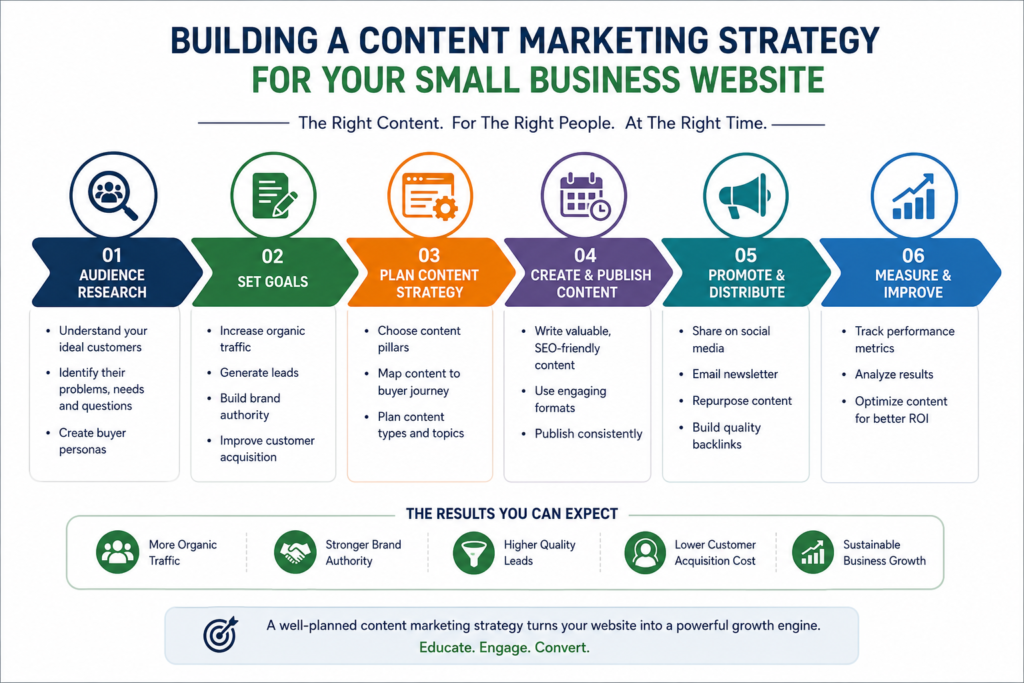
Step 1: Start with Audience Research
Before writing a single article, understand who you’re writing for.
Great content begins with knowing your audience—not guessing.
Ask questions such as:
- What problems do they face?
- What questions do they ask before buying?
- What objections prevent them from purchasing?
- What information are they searching for online?
- Which platforms do they use?
Create Buyer Personas
A buyer persona is a fictional profile representing your ideal customer.
Include details such as:
- Age
- Profession
- Industry
- Income level
- Goals
- Challenges
- Preferred communication channels
- Buying motivations
For example:
Business Owner Sarah
- Runs a local bakery
- Limited marketing budget
- Wants more website traffic
- Needs affordable marketing ideas
- Searches Google before hiring agencies
Now your content can directly address Sarah’s concerns instead of trying to appeal to everyone.
Step 2: Build a Website Content Strategy: best for Content Marketing Strategy for Small Business Website
Your website shouldn’t function as a digital brochure.
Instead, it should become your most valuable marketing asset.
A successful website content strategy includes multiple types of pages that work together.
Core Website Pages
Every small business should have:
- Homepage
- Services
- About
- Contact
- FAQs
- Testimonials
- Case Studies
These pages establish credibility and help visitors understand your business.
Educational Content
Educational content attracts potential customers during the research phase.
Examples include:
- How-to guides
- Industry tips
- Checklists
- Tutorials
- Comparison articles
- Beginner guides
This type of content builds trust before asking visitors to make a purchase.
Evergreen Content
Evergreen articles remain useful for years.
Examples:
- Beginner guides
- Frequently asked questions
- Step-by-step tutorials
- Industry best practices
Evergreen content compounds your organic traffic over time.
Step 3: Map Content to the Buyer Journey
One common mistake small businesses make is creating only sales-focused content.
Customers rarely buy immediately.
Instead, they move through a journey.
Understanding this buyer journey helps you create content that meets users where they are.
Awareness Stage
At this stage, potential customers are identifying a problem.
Content examples:
- What is content marketing?
- Why isn’t my website getting traffic?
- SEO vs paid ads
- Common digital marketing mistakes
Goal:
Build awareness and attract new visitors.
Consideration Stage
Now readers know their problem and are evaluating solutions.
Content ideas:
- Best content marketing strategies
- Website redesign checklist
- Content marketing examples
- Comparing DIY marketing vs hiring experts
Goal:
Position yourself as the trusted solution.
Decision Stage
Now prospects are ready to hire.
Content examples:
- Pricing guides
- Client success stories
- Portfolio
- Service pages
- Testimonials
- Free consultations
Goal:
Generate leads and customer acquisition.
Understanding the Content Funnel
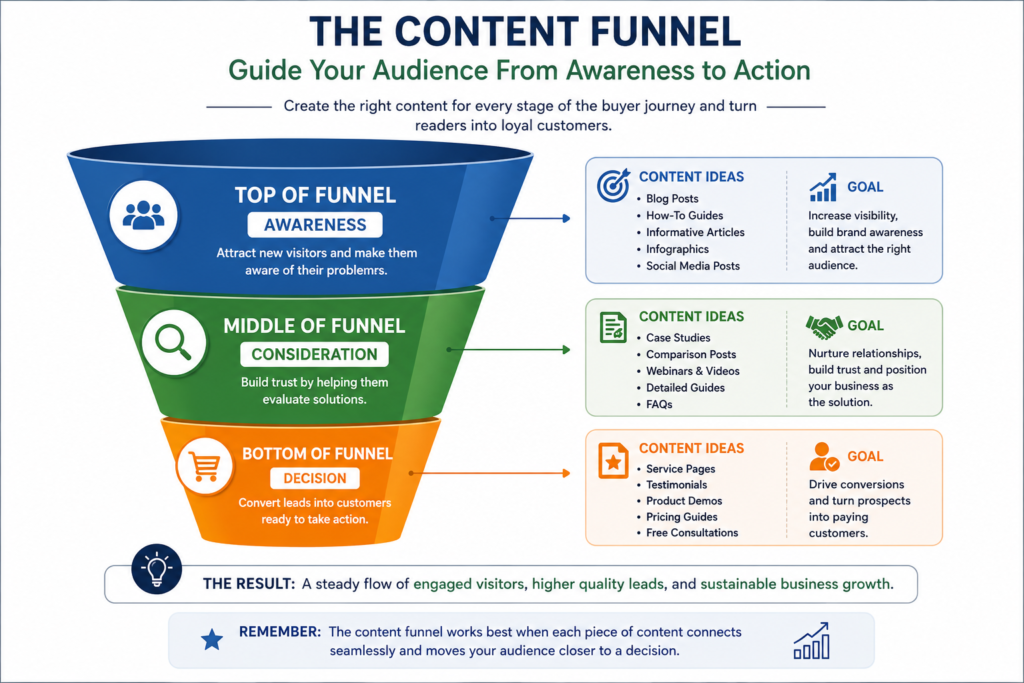
Your content funnel mirrors the buyer journey and ensures you have content for every stage.
| Funnel Stage | Purpose | Example Content |
|---|---|---|
| Top of Funnel | Attract traffic | Blogs, guides, educational articles |
| Middle of Funnel | Build trust | Case studies, webinars, comparison posts |
| Bottom of Funnel | Convert visitors | Service pages, testimonials, consultations |
Without a balanced content funnel, businesses often attract visitors but fail to convert them into paying customers.
Step 4: Focus on Search Intent, Not Just Keywords
Ranking well on Google isn’t about repeating keywords. It’s about satisfying search intent.
Ask yourself:
- What is the user trying to accomplish?
- Are they looking for information?
- Comparing options?
- Ready to buy?
- Looking for local services?
When your content directly answers these questions, search engines are more likely to reward it with higher rankings.
For example, someone searching content plan for small business wants practical guidance—not a sales pitch. Providing actionable steps, templates, and examples increases engagement while building trust.
Key Takeaways So Far for Content Marketing Strategy for Small Business Website
By this point, you should understand that an effective content marketing strategy for a small business website starts with research, planning, and aligning content with customer intent—not simply publishing articles.
In Part 2, we’ll cover how to create a content plan, build an effective content calendar, measure content marketing ROI, explore real-world content marketing examples, answer common FAQs, and finish with actionable next steps to help you turn website visitors into paying customers.
Step 5: Create a Practical Content Plan for Small Business
Once you’ve identified your audience and mapped their buyer journey, it’s time to organize your ideas into an actionable content plan for small business.
Rather than creating content whenever inspiration strikes, build a plan around your business goals and customer questions.
Start with Content Pillars
Content pillars are broad topics that represent your expertise. Every blog, guide, video, or social media post should fit under one of these themes.
For example, if you’re a content marketing consultant, your pillars might include:
- Content Marketing
- SEO
- Website Content Strategy
- Blogging
- Lead Generation
- AI & AEO Optimization
- Digital Marketing Tips
Each pillar can generate dozens of supporting articles, helping search engines understand your expertise while keeping your content organized.
Use the 80/20 Rule
A common mistake is making every piece of content promotional. Instead, follow this balance:
- 80% educational content: Answer questions, solve problems, and provide value.
- 20% promotional content: Showcase services, case studies, testimonials, and offers.
This approach builds trust before asking readers to become customers.
Step 6: Build a Content Calendar for Small Business
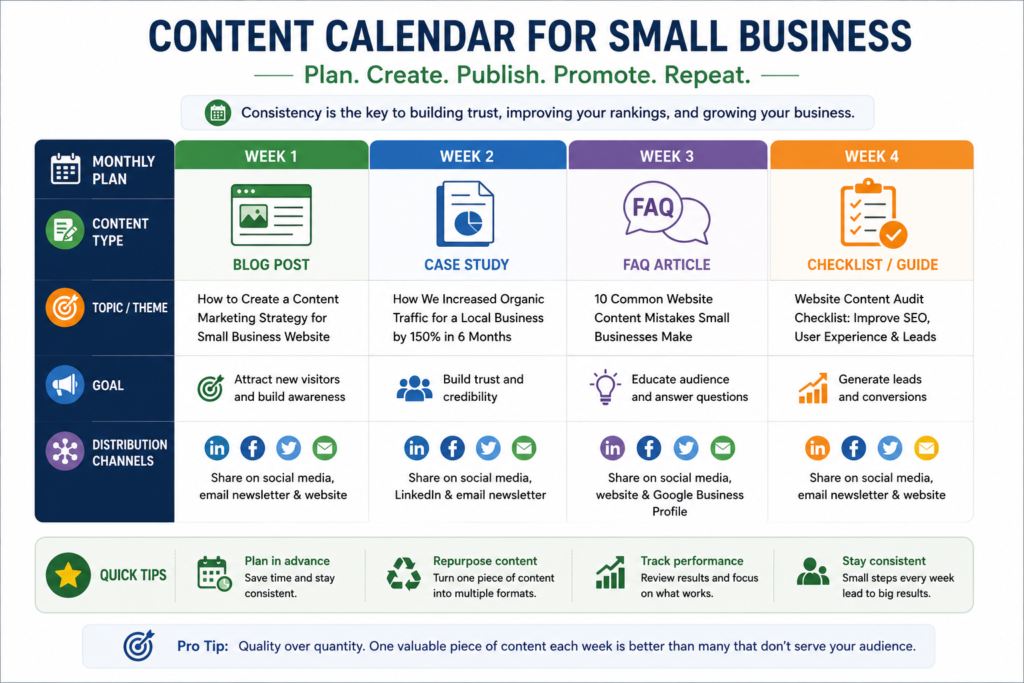
Consistency matters more than frequency.
A simple content calendar for small business ensures you’re publishing regularly without feeling overwhelmed.
Sample Monthly Content Calendar (Sample)
| Week | Content Type | Topic |
|---|---|---|
| Week 1 | Blog | How to Create a Content Marketing Strategy for a Small Business Website |
| Week 2 | Case Study | How We Increased Organic Traffic for a Local Business |
| Week 3 | FAQ Article | Common Website Content Mistakes Small Businesses Make |
| Week 4 | Checklist | Website Content Audit Checklist |
Repurpose each blog into:
- LinkedIn posts
- Instagram carousels
- Email newsletters
- Short-form videos
- Infographics
- Google Business Profile updates
One well-written blog can become 8–10 pieces of content across different channels.
Content Marketing Examples Small Businesses Can Learn From
Looking at successful content marketing examples can inspire your own strategy.
Example 1: Local Dentist
Instead of relying solely on service pages, they publish blogs such as:
- How Often Should You Visit a Dentist?
- Teeth Whitening: Myths vs Facts
- What to Expect During Your First Dental Visit
These articles answer common questions and attract potential patients through organic search.
Example 2: Interior Designer
Their content includes:
- Small Apartment Design Ideas
- Modern Living Room Trends
- Budget-Friendly Home Makeovers
Readers searching for inspiration discover the business long before they’re ready to hire, creating a steady pipeline of qualified leads.
Example 3: Marketing Consultant
Publishing articles on SEO, blogging, website optimization, and content strategy positions the consultant as an expert. By consistently educating readers, they attract businesses already looking for marketing solutions.
The takeaway: Great content solves problems before selling services.
How to Measure Content Marketing ROI
One of the biggest misconceptions about content marketing is that it’s impossible to measure.
In reality, tracking content marketing ROI is essential for improving your strategy and justifying your investment.
Key Metrics to Monitor
- Organic traffic growth
- Keyword rankings
- Time on page
- Bounce rate
- Lead generation
- Email sign-ups
- Contact form submissions
- Conversion rate
- Customer acquisition cost
Simple ROI Formula
Content Marketing ROI = ((Revenue from Content – Content Costs) ÷ Content Costs) × 100
For example:
- Content investment: ₹40,000
- Revenue generated: ₹1,60,000
ROI = ((₹1,60,000 − ₹40,000) ÷ ₹40,000) × 100 = 300%
Because quality content continues attracting visitors over time, its long-term ROI often surpasses paid advertising.
Common Content Marketing Mistakes Small Businesses Should Avoid
Avoid these pitfalls to maximize the impact of your content efforts:
1. Writing Without a Strategy
Random blog topics rarely produce consistent traffic or leads. Every piece should align with a business objective.
2. Ignoring SEO
Great content won’t perform if search engines can’t understand or discover it. Optimize headings, internal links, metadata, and search intent—not just keywords.
3. Forgetting the Buyer Journey
Not every visitor is ready to buy. Create content for awareness, consideration, and decision stages to nurture prospects over time.
4. Publishing Inconsistently
Posting several blogs one month and then disappearing for six months weakens momentum. A realistic publishing schedule is more effective.
5. Focusing Only on Search Engines
Write for people first. Helpful, engaging content naturally performs better in search results and builds trust with readers.
Quick Answers
A content marketing strategy for a small business website is a plan for creating, publishing, and promoting valuable content that attracts the right audience, improves search visibility, generates leads, and supports business growth.
Most small businesses should aim to publish 2–4 high-quality blog posts per month. Consistency and relevance are more important than publishing daily.
Yes. Content marketing for local business helps improve local search visibility, answers customer questions, builds authority, and generates qualified leads without relying solely on paid advertising.
While some improvements can appear within a few weeks, meaningful gains in organic traffic and lead generation typically take 3–6 months, with stronger results building over time.
Frequently Asked Questions
A content plan should define your goals, target audience, content pillars, publishing schedule, SEO strategy, distribution channels, and key performance indicators (KPIs). It serves as the roadmap for all your content efforts.
Successful examples include educational blog posts, case studies, customer success stories, FAQs, how-to guides, comparison articles, videos, email newsletters, and downloadable checklists. The best content addresses customer questions while demonstrating your expertise.
A website content strategy ensures every page has a purpose. It improves user experience, supports SEO, increases organic traffic, and guides visitors toward becoming customers.
Improve ROI by targeting the right keywords, publishing consistently, updating older content, tracking performance metrics, optimizing conversions, and creating content that matches every stage of the buyer journey.
Content attracts potential customers through search engines, builds trust by answering their questions, nurtures them with valuable information, and encourages them to contact your business when they’re ready to buy.
Final Thoughts
An effective content marketing strategy for a small business website isn’t about publishing more content—it’s about publishing the right content.
When you combine audience research, a clear website content strategy, an organized content plan, a consistent content calendar, SEO best practices, and valuable resources for every stage of the content funnel, you create a system that consistently attracts qualified visitors and converts them into loyal customers.
Content marketing is a long-term investment, but unlike short-lived advertising campaigns, every well-optimized article becomes a digital asset that continues generating organic traffic, supporting lead generation, and lowering customer acquisition costs for years to come.
If your goal is sustainable business growth, now is the time to stop creating random content and start building a strategy that works.
Ready to Grow Your Business with Strategic Content?
If you’re looking for a content marketing strategy for a small business website that attracts the right audience, improves search rankings, and converts visitors into paying customers, I’m here to help.
Whether you need SEO blog writing, website content, pillar pages, content planning, or a complete content marketing strategy, I’ll create content tailored to your business goals.
👉 Explore my Content Marketing Services: https://nehalvira.com/content-marketing-services/
Let’s build content that doesn’t just rank—it drives measurable business growth.